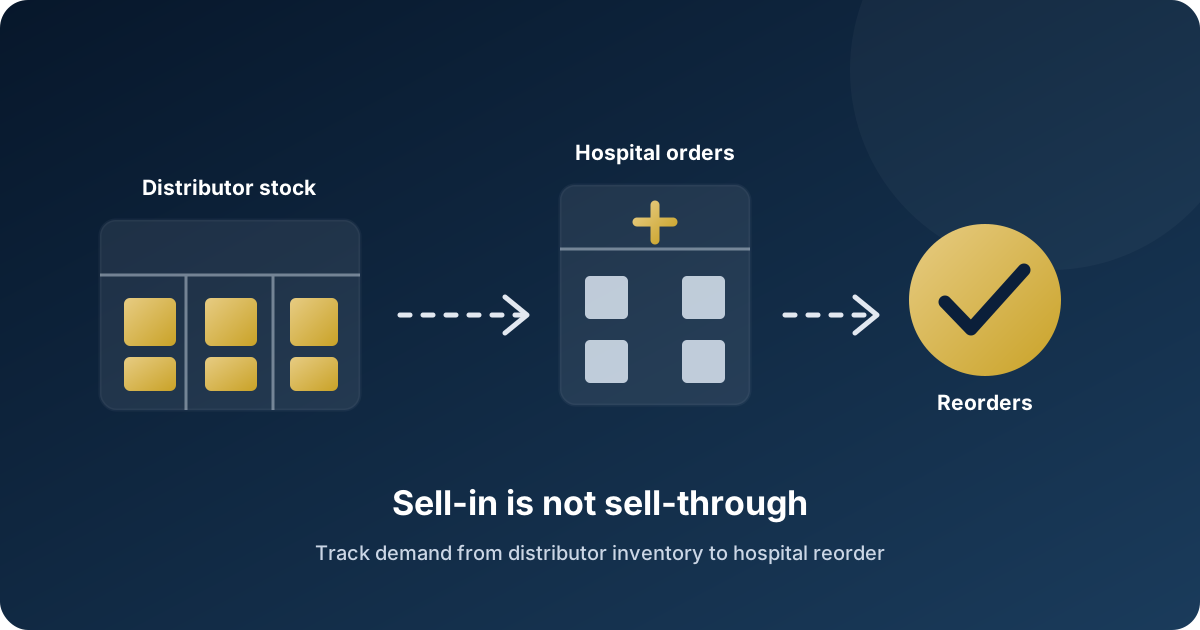
Distributor sell-through and customer demand in Asia-Pacific MedTech depend on what happens after the opening order. This applies to any medical device distributor in APAC that has placed an opening order but not generated customer orders.
A large distributor, strong hospital access, exclusivity, and a big opening order can make a launch look successful. But these signals show reach and willingness to stock. They do not show that customers are buying. The question is simple: what happens after the product arrives? Does the distributor generate customer orders and repeat purchases, or only report more activity?
The answer often appears months later. Inventory is still in the channel, follow-ups are limited, and no customer has placed an order or reordered. That does not automatically mean the hospital demonstration failed. It may mean the distributor has not turned access into sales.
Keep three events separate: the distributor buys stock; a customer evaluates the product; a customer places an order. The first shows commitment to stock. The second shows interest. The third shows customer demand. A repeat order shows whether the distributor can sell the product again.
Separate channel inventory from customer demand
Start with the opening order. It shows what the distributor has in stock, not what customers have bought. Until you can name the customer and verify the order, do not treat that stock as proof of demand.
For an Asia-Pacific launch, review the numbers account by account. Ask for five facts: units sold, customer name, invoice or order date, remaining and ageing units, and next replenishment date. Then verify that the products have reached the customer and are being used—not sitting in a warehouse, remaining unused, or returned. Where practical, verify a sample of customer accounts directly. Without these checks, reported sales may not represent genuine customer adoption.
use this information to assess the first customer order. Treat it as an initial signal, not proof of a pattern. Look for a separate purchase or replenishment from another customer. A tender or unusually large account can create a one-off spike, so wait for another customer before calling demand repeatable.
Treat hospital demonstrations as a handoff, not as sell-through
The same test applies to demos. a hospital demonstration matters only when the distributor turns it into a next step: a named buying account, a procurement contact, a quote request, or an order. Without one, the hospital demonstration shows activity—not a sale.
For each hospital demonstration, ask for the account, decision-maker, current stage, next action, owner, and date. These details show whether the distributor is moving the opportunity forward.
Once those details are available, ask:
What changed at the account after the hospital demonstration?If the answer is only “still interested,” the distributor has not recorded a clear step toward an order.
Scale and exclusivity do not prove execution
That account-level test leads to a practical question: does the distributor have enough sales capacity to move these opportunities? Company size and exclusivity do not answer it. You need to know how many people sell the product, how often they follow up, and how many customer sales they can generate each quarter.
Map the people behind the territory. Which representative owns each customer account? Which other brands or product lines compete for that person’s time?
Who owns the account after the hospital demonstration—and what else are those people responsible for?This tells you more about sales capacity than headcount alone.
Capacity is not the only possible problem. Slow sales may also reflect product positioning, clinical education, procurement timing, or distributor neglect. Compare the distributor’s activity with customer orders and ageing stock before changing the product or the market.
Test the distributor’s report against sell-through
Use information beyond the pipeline report. Check customer confirmations, order data, medical device inventory ageing and replenishment history. Together, they show whether reported activity is becoming real customer demand and sales.
For an Asia-Pacific MedTech distributor, review the result by country, account, representative, and quarter. Track opening stock, units sold, sell-through rate, ageing stock, dated next steps, and repeat orders. If these measures do not improve, more demos will not solve the problem.
Five signs your medical device distributor is not generating demand
Use this short review before placing more stock, extending exclusivity or assuming the market is ready to scale:
- Opening stock is reported, but customer sell-through is not. Ask for customer-level orders and supporting sales data.
- Demos have no accountable next step. Each opportunity should have a named owner, action and date.
- Account activity is not progressing towards procurement. Track quote requests, budget discussions, tender requirements and decision timing where relevant.
- Inventory is ageing without a replenishment plan. Review remaining stock, expected use and realistic reorder timing.
- There are no repeat orders from customers. Distinguish an initial order or one-off tender from repeatable customer demand.
Ask the distributor to review these indicators account by account. If the data is missing, agree what will be reported and by when before committing additional medical device stock or territory rights.
Before adding stock or extending exclusivity, ask:
What shows this distributor is turning medical device inventory into customer orders and repeat demand?